
Hermès Kelly to Go vs Constance to Go: Which Holds Value Better?
Market Intelligence: Evaluating the Liquidity and Profit Deltas of the WOC Ecosystem
Debating Hermès Kelly to Go vs Constance to Go: which holds value better forces the luxury investor to analyze the most intensely competitive sub-sector of the modern accessories market. The "Wallet on Chain" (WOC) category has fundamentally disrupted traditional handbag economics. In 2026, buyers are ruthlessly prioritizing hyper-functional, micro-sized assets over cumbersome totes. Hermès capitalized on this shift by mounting detachable straps onto their most iconic wallet silhouettes, birthing the Kelly to Go (KTG) and the Constance to Go (CTG). While officially classified as Small Leather Goods (SLGs)—meaning they technically do not consume an annual quota bag slot—the boutique gatekeeping surrounding them is absolute. Sales Associates deploy these assets as high-leverage rewards for clients building their profiles. Consequently, the secondary market treats them with extreme reverence, generating price-to-resale ratios that routinely eclipse full-sized non-quota bags. However, assuming these two models perform identically on resale platforms is a critical portfolio error. They attract different buyer demographics and suffer from drastically different condition grade vulnerabilities. In this comprehensive head-to-head analysis, we will deconstruct their retail baselines, map their price deltas across major platforms, and declare exactly which asset offers the ultimate capital preservation.
+40% to +60%
Kelly to Go Resale Premium
+20% to +40%
Constance to Go Resale Premium
Pristine
Condition Grade Mandatory for Max ROI
Table of Contents
The Foundation: SLG Categorization and Boutique Friction
To accurately evaluate the return on investment (ROI) for these pieces, one must first consult our Comparisons Hub to understand their exact retail classification. In the Hermès ecosystem, neither the Kelly to Go nor the Constance to Go is technically a "bag." They are classified internally as Small Leather Goods (SLGs). For the investor, this classification is a double-edged sword.
On one hand, purchasing an SLG does not exhaust your strict annual limit for quota bags (Birkins and Kellys). On the other hand, the capital spent on an SLG does not mathematically advance your spend ratio. If you purchase a $5,500 Constance to Go, your Sales Associate (SA) receives minimal commission compared to selling you a $5,500 diamond bracelet. Therefore, despite their SLG classification, SAs gatekeep these "To Go" models aggressively. You cannot simply walk into a flagship boutique and purchase one; they are held in the vault and offered specifically to keep mid-tier clients engaged while they wait for a primary quota allocation.
This intense retail friction acts as a massive pressure cooker for the secondary market. Buyers on Vestiaire Collective, The Real Real, and 1stDibs are acutely aware of how difficult it is to secure these items. Because the retail price points (ranging approximately from $4,800 to $5,800) are highly accessible compared to a $12,000 Birkin, the secondary buyer pool is exponentially larger. This immense demand slamming into tightly throttled boutique supply guarantees that both the KTG and CTG will trade at a significant premium. The question for the investor is simply which premium is mathematically superior.
The Kelly to Go (KTG): Apex Velocity and Stealth Wealth
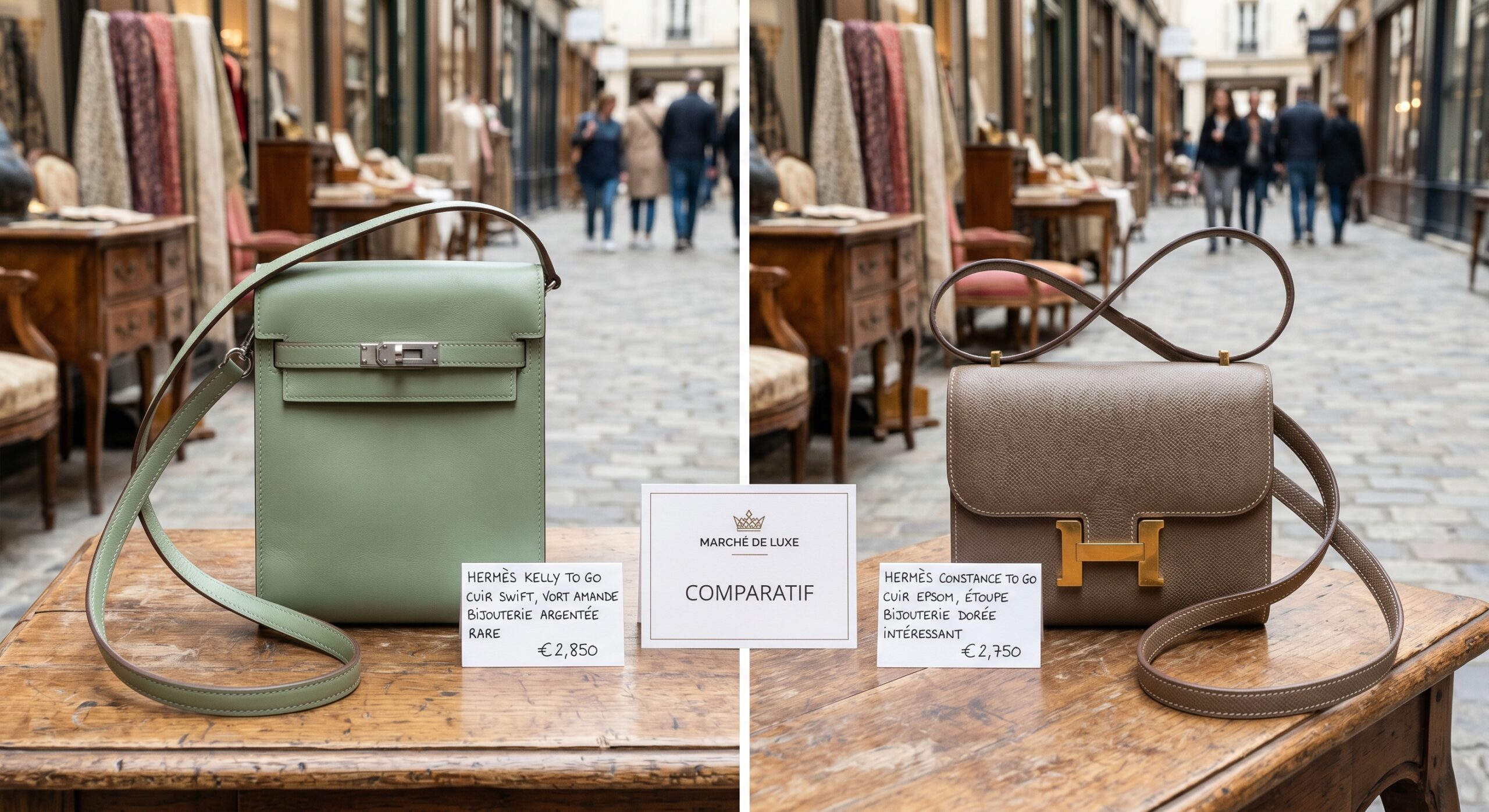
When analyzing direct secondary market transaction data, the Kelly to Go (KTG) is the undisputed volume leader of the SLG sector. Retailing for roughly $4,800 in Epsom leather, the KTG is the minimalist distillation of the iconic Kelly bag, featuring the signature sangles and touret (turn-lock) closure.
On direct-buyout platforms like Fashionphile, a Pristine KTG in a universally demanded neutral (such as Noir, Gold, or Craie) operates with staggering velocity. It functions essentially as cash. The price-to-resale ratio frequently commands a +40% to +60% premium over retail, allowing sellers to clear $7,000 to $8,000 effortlessly. As we explored in our broader Birkin vs Kelly value retention analysis, the modern luxury consumer is leaning heavily into the architectural "stealth wealth" aesthetic. The KTG satisfies this demand perfectly. It is instantly recognizable to the educated eye, yet lacks the ostentatious branding of its competitors.
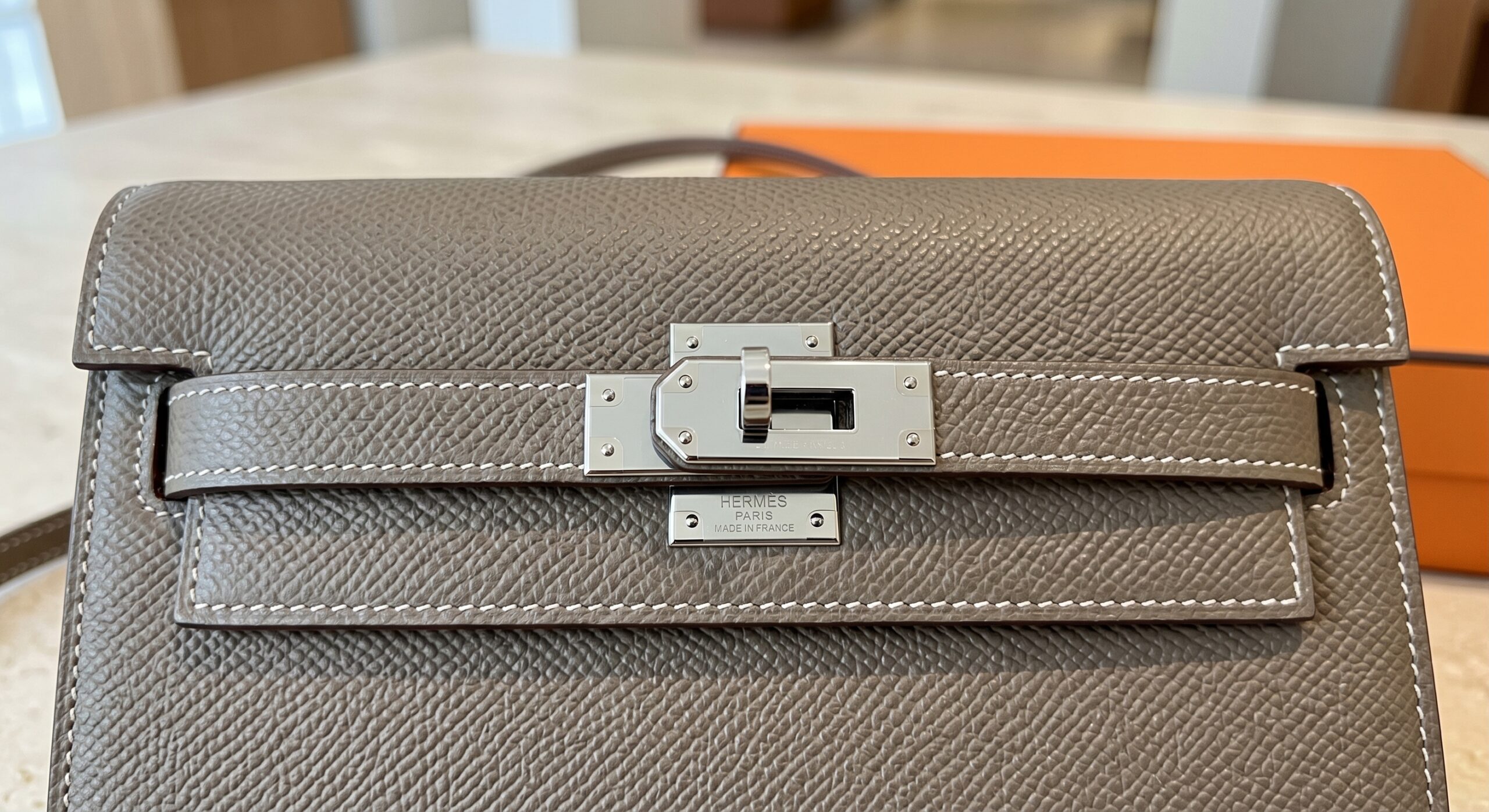
Furthermore, the KTG excels at condition grade defense. Because the hardware is minimal and centralized, and the structure is typically crafted in rigid Epsom or Chevre leather, it resists daily wear beautifully. The primary physical vulnerability is the edge glazing where the strap attaches to the wallet. If the bag is routinely overloaded, this resin can crack, dropping the condition grade to "Very Good" and instantly wiping out $1,000 of the price delta.
- The Kelly to Go offers the highest percentage markup over retail in the SLG category.
- Epsom leather is the mandatory standard; avoid smooth, easily scratched leathers to preserve the condition grade.
- Do not detach and lose the strap; the KTG without its original strap becomes functionally illiquid.
The Constance to Go (CTG): The Hardware Liability
The Constance to Go (CTG) presents a distinct, slightly heavier aesthetic. Retailing at a higher baseline—approximately $5,500 to $5,800 due to its complex hardware—it essentially functions as a flattened version of the Constance 18. For context on how the full-sized bag performs, refer to our Constance vs Birkin investment guide.
While the CTG possesses immense visual impact, its price delta on the secondary market is slightly compressed compared to the KTG. A Pristine CTG will typically yield a +20% to +40% premium. Why does the more expensive retail item yield a lower percentage markup? The answer lies in buyer psychology and condition grade vulnerabilities.
The 'H' Buckle Scratch Penalty
The defining feature of the Constance to Go is the massive metal 'H' buckle. In the WOC format, this bag bounces against the hip and is constantly subjected to friction from zippers, seatbelts, and rings. The 'H' buckle is a magnet for micro-scratches. Secondary buyers are ruthless regarding hardware condition. A single visible scratch drops the CTG out of "Pristine" status instantly. Because the retail price is already high, buyers on Vestiaire Collective refuse to pay an additional $3,000 premium for an asset that shows visible wear. To protect your investment, you must apply aftermarket protective films to the buckle immediately, or risk a severe contraction of your price-to-resale ratio. For a comprehensive look at how these visual accents influence styling and demand, our sister site provides an excellent Hermès wallet-on-chain color and hardware styling strategy.
Additionally, the CTG is physically bulkier than the KTG. In an era where micro-bags dominate, the slightly heavier profile of the Constance to Go causes it to sit on resale platforms just a fraction longer than its sleeker Kelly counterpart. It remains a highly profitable asset, but its liquidity velocity is undeniably second-tier.

Practical Implications and Liquidation Strategy
If you are engineering an acquisition strategy specifically to capture secondary market premiums, your instructions to your SA must be explicit. While both items are excellent tools for parking capital, the Kelly to Go provides superior downside protection and a higher upside delta.
When you are offered an SLG allocation, prioritize the KTG in classic neutrals (Craie, Gold, Noir) with Gold Hardware (GHW). If you are offered a CTG, you must evaluate the hardware critically. A CTG with Rose Gold Hardware (RGHW) can occasionally offset the model's standard price delta compression, as RGHW is highly sought after by specific international collector demographics. We detailed the exact premium multipliers of these metals in our HSS special order resale value analysis.
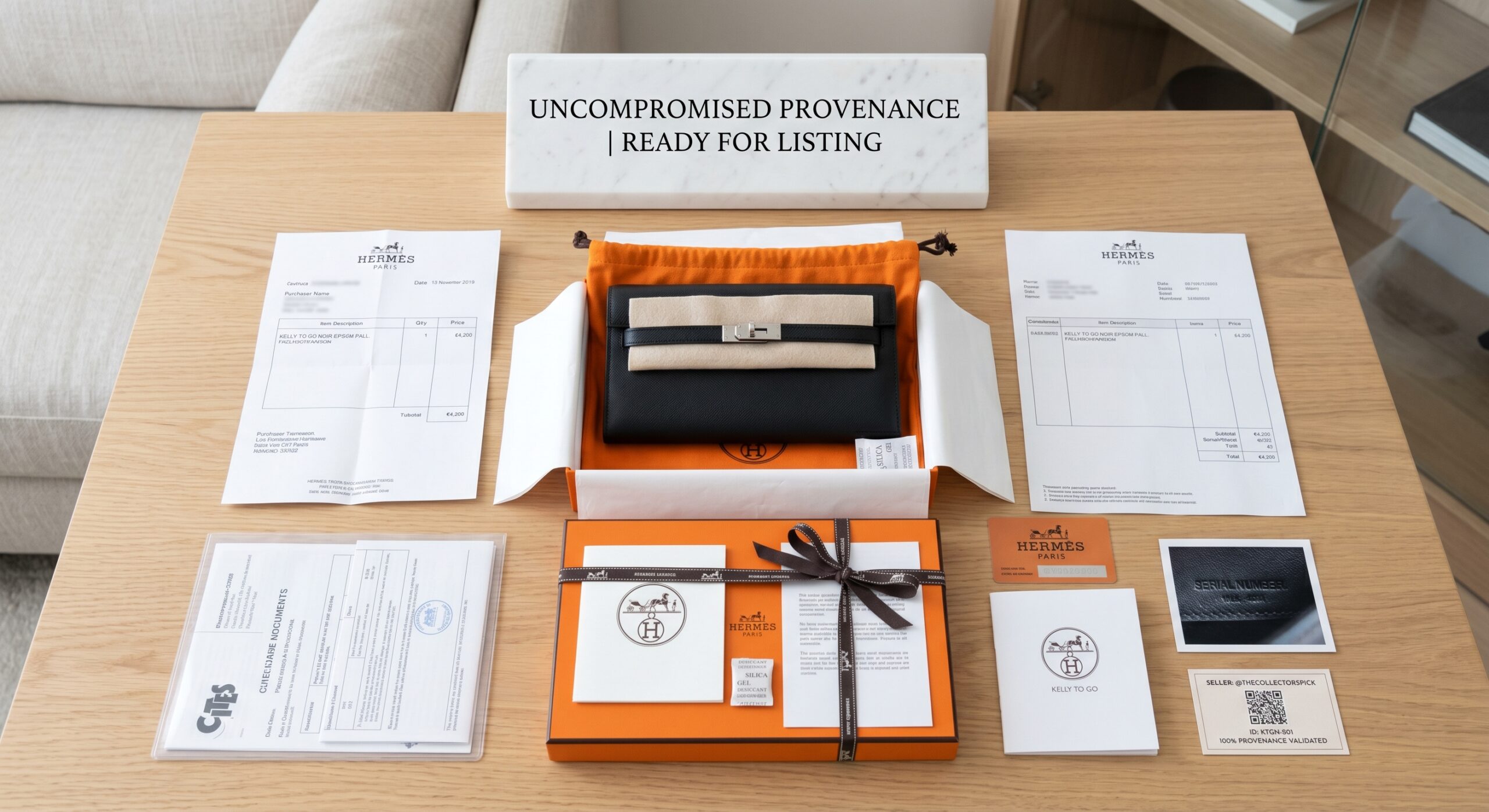
When it is time to liquidate, timing and presentation are critical. Because these items are highly seasonal—peaking in demand during summer travel and winter holidays—you must list them strategically. Ensure that the interior felt protectors (provided by the boutique to prevent the interior zipper from indenting the leather) are intact and included in your photography. Buyers paying $7,000 for a wallet demand absolute, factory-fresh perfection. Missing the original box or the interior felt will instantly cost you 5% to 10% of your final payout.
| Model (Epsom Leather) | Estimated Retail (2026) | Primary Condition Vulnerability | Resale Premium / Liquidity |
|---|---|---|---|
| Kelly to Go (KTG) | ~$4,800 | Resin edge cracking at strap loops | +40% to +60% / Ultra-High |
| Constance to Go (CTG) | ~$5,500 - $5,800 | Severe 'H' buckle scratching | +20% to +40% / High |
| KTG in Exotic (Alligator) | ~$15,000+ | Scale lifting / Water damage | Apex Premium / Niche Velocity |
| Vintage Kelly Wallet (No Strap) | N/A (Discontinued format) | Outdated utility (Requires conversion) | Retail Parity / Low |
The Market Insider's Verdict
The "To Go" category offers some of the most reliable percentage returns in the Hermès portfolio, but condition grading dictates the victor. The massive hardware on the Constance to Go acts as a relentless liability to its condition grade. Bottom Line: The Kelly to Go is the vastly superior investment. Its lower retail entry point, minimalist hardware, and alignment with the modern stealth wealth aesthetic guarantee a higher percentage price delta and significantly faster liquidity on every major resale platform.
Popular Searches
Explore our most searched WOC investment and liquidity questionsKelly to Go vs Mini Kelly Resale Value
Tracking the massive price delta gap between a pseudo-quota SLG and a true quota micro-bag.
📈 Strong ResaleDoes the Kelly to Go Fit an iPhone Pro Max
Analyzing how functional utility directly correlates with secondary market velocity in 2026.
⬆ Rising DemandConstance to Go Rose Gold Hardware Premium
Why specific metallic alloys are required to rescue the price-to-resale ratio of the CTG.
★ Collector FavouriteDo SLGs Count Toward Birkin Spend Ratio
Understanding the severe limitations of purchasing wallets to advance your boutique relationship.
