
Hermès Market & Investment Glossary: Every Term You Need
Market Intelligence: The Definitive Dictionary for the Modern Luxury Investor
Navigating the secondary luxury market requires absolute fluency; our Hermès Market & Investment Glossary: Every Term You Need serves as the definitive translation matrix for protecting and multiplying your capital. In 2026, the Hermès ecosystem operates as an unregulated financial exchange, governed by its own opaque terminology, unwritten boutique rules, and ruthless grading metrics. If a collector does not understand the distinct mathematical difference between a price delta and a price-to-resale ratio, they will inevitably miscalculate their ROI. If an investor falls into the psychological trap of the mythical wait list rather than engineering a calculated spend ratio, their capital remains stranded. To interact successfully with a Sales Associate, or to confidently list a six-figure asset on a resale platform, you must speak the language of the market insider. In this exhaustive reference guide, we strip away the marketing romance to define the core vocabulary of Hermès acquisition, secondary market liquidity, and condition grading—equipping you with the precise lexicon required to dominate negotiations and secure apex investments.

12
Core Financial Metrics Defined
Essential
For SA Negotiations
Mandatory
For Secondary Market Listings
Table of Contents
Section 1 — The Foundation of Acquisition
The journey of every luxury asset begins at the retail level. To successfully extract a high-yield asset from an Hermès boutique, you must understand the structural hierarchy and the unwritten financial rules that dictate inventory allocation. For a broader overview of how these terms fit into the entire ecosystem, bookmark our central Hermès Terminology Glossary.
Quota Bag: The foundational asset of the Hermès portfolio. Strictly defined as a Birkin or a Kelly (and occasionally the Constance, depending on regional boutique rules). A quota bag is not freely purchasable; it is only accessible through an established boutique relationship and a verified spend history. Clients are strictly limited by corporate policy on how many they can acquire annually (typically two).
SA (Sales Associate): The boutique relationship holder who acts as your internal portfolio manager. The SA controls quota bag allocation. They do not merely ring up purchases; they must advocate for your profile to the boutique director during closed-door inventory meetings. Your financial success relies entirely on their willingness to fight for your requests.
Spend Ratio: The core mathematical metric of Hermès acquisition. This is the ratio of non-quota purchases (fine jewelry, homeware, ready-to-wear) required relative to the retail price of the quota bag you desire. A 2:1 spend ratio dictates that you must purchase $20,000 worth of peripheral goods to unlock a $10,000 Birkin. This required pre-spend acts as the "shadow cost" of the asset.
Boutique Relationship: The SA-client dynamic that determines quota access. It is not built on friendliness; it is built through spend history, purchasing consistency, and genuine engagement with high-margin departments. A strong boutique relationship bypasses informal delays.
Wait List: The informal boutique queue for quota bags. It is vital to understand that this is not an official Hermès system but a real SA relationship dynamic. It is not chronological; you do not move up the list by waiting. You move up the list by actively increasing your spend ratio.
Section 2 — Secondary Market Economics
Once a quota bag is acquired, it transitions into a financial instrument. The following terminology governs how that asset is valued, traded, and liquidated on the open market.
Resale Platform: The digital infrastructure where secondary market transactions occur. The "Big Four" include Vestiaire Collective, The Real Real, Fashionphile, and 1stDibs. Each operates as a distinct resale platform with different buyer pools, consignment fees, and direct-buyout algorithms that heavily influence your final net profit.
Price Delta: The measurable price difference between two configurations, conditions, or platforms. It is always expressed as a percentage or a specific dollar range. For example, the price delta between a Birkin 25 and a Birkin 35 on the secondary market can easily exceed 40%, reflecting the massive disparity in buyer demand.
Price-to-Resale Ratio: The ratio of the original boutique retail price to the asset's secondary market value. This is the core investment metric for any Hermès acquisition. A Birkin 25 with a retail price of $11,000 that sells for $22,000 possesses a 2.0x (or +100%) price-to-resale ratio.
Liquidity: A measure of market velocity. It dictates how quickly and at what price a bag can be sold on the secondary market. Liquidity varies significantly by model, size, color, and hardware. A pristine Craie Birkin 25 has ultra-high liquidity (selling in under 48 hours), while a heavily worn Birkin 40 in a seasonal bright color suffers from severe illiquidity (sitting unsold for months).
- Maximize your price delta by strictly acquiring sizes 25 and 28 in classic, universal neutrals.
- Monitor the buyout offers from various resale platforms; direct buyouts offer immediate liquidity but sacrifice a portion of the price-to-resale ratio.
- Understand that retail price hikes automatically manipulate the secondary market price delta upward.

Section 3 — Provenance and Condition Management
The premium attached to an Hermès asset is intensely fragile. The market uses strict forensic grading to protect buyers from depreciation and counterfeits.
Condition Grade: The platform-specific quality rating that directly affects the resale price. Grading scales vary (A, B+, B, C on Vestiaire Collective; Pristine/Excellent/Good on The Real Real). A downgrade from Pristine to Excellent due to minor corner wear can instantly erase thousands of dollars from the asset's price delta. For insights on how authenticators evaluate metallic wear, our sister site breaks down the science of Hermès hardware tarnishing and condition grading.
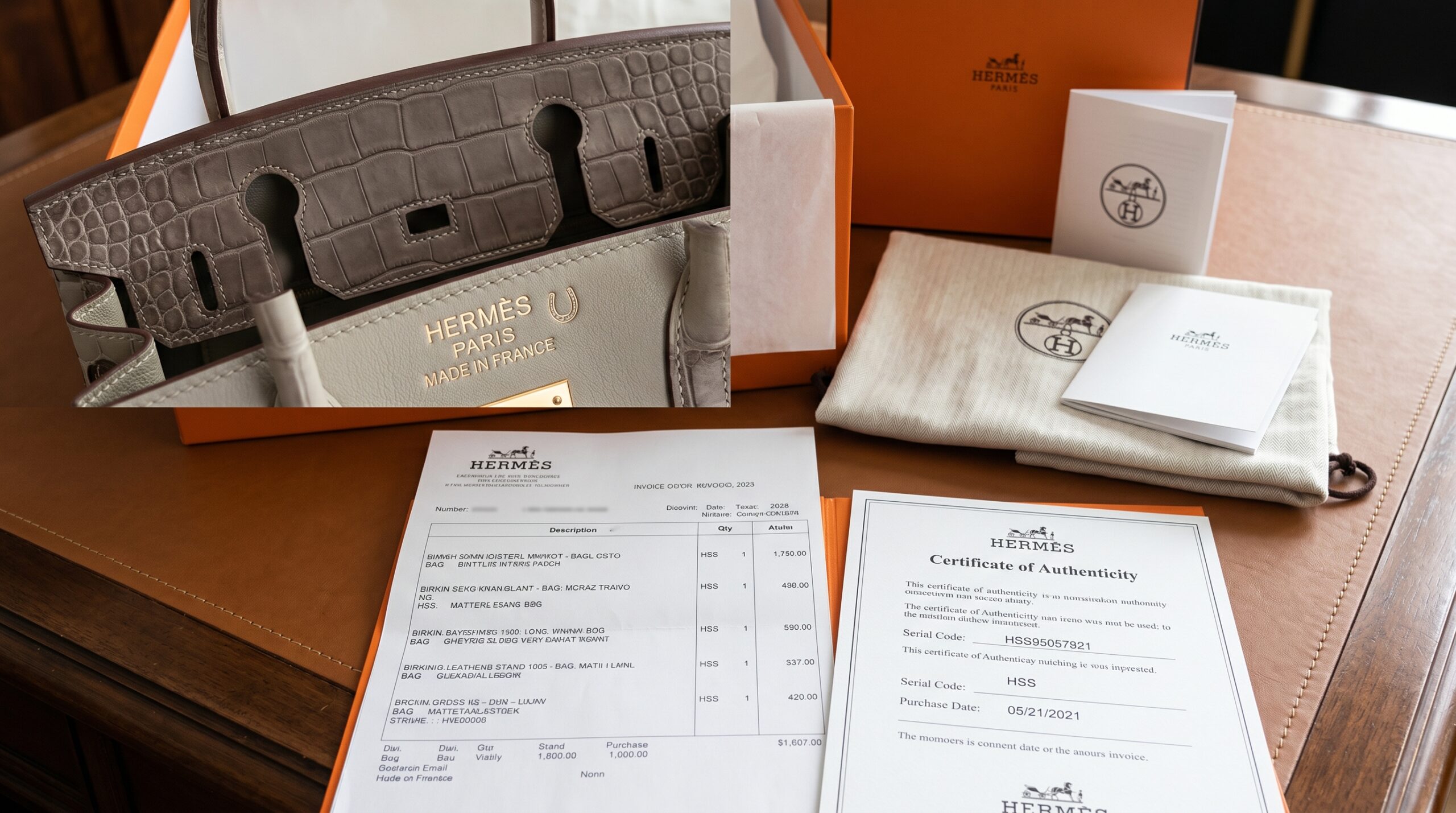
Provenance: The documentary history of a bag. Perfect provenance includes the original boutique receipt, the authenticity/CITES card, the orange box, dust bags, and the raincoat. Flawless provenance maximizes buyer confidence and is mandatory to achieve the absolute peak price-to-resale ratio. A missing receipt introduces massive friction into the transaction.
HSS (Hermès Special Service)
HSS stands for Hermès Special Service—the highly restricted special-order program allowing top-tier VIP clients to select custom leather, color, and hardware combinations. Identifiable by a discrete foil horseshoe stamp next to the logo. While an HSS stamp implies elite status, its liquidity is entirely dependent on the aesthetic choices made. A tone-on-tone neutral HSS commands an apex premium; a highly contrasting, polarizing HSS often results in negative liquidity.
Section 4 — Practical Application in 2026
Mastering this vocabulary is only useful if it dictates your operational strategy. In 2026, the secondary market is undergoing a structural correction, heavily penalizing uneducated collectors. As we established in our reseller market price drop analysis, buyers are weaponizing condition grades to negotiate aggressive discounts on anything less than perfect.
When you approach your SA, you must mentally calculate the required spend ratio against the historical retail adjustments we track in our price increase history analysis. If the retail baseline is rising by 10% annually, your mandatory pre-spend is simultaneously becoming more expensive. You must act decisively to lock in your allocations before the financial goalposts move.
If you are forced to liquidate an asset where the provenance has been compromised, you must adjust your expectations regarding liquidity. As we detail in our guide on selling Hermès without a receipt, the absence of original documentation will force you to absorb a severe penalty on your price-to-resale ratio, regardless of the physical condition grade. For a macro view of how all these elements combine, explore our complete All Topics directory.

| Term Category | Core Vocabulary Term | Direct Investment Impact | Secondary Market Liquidity Effect |
|---|---|---|---|
| Boutique Acquisition | Spend Ratio | Dictates the total sunk cost required to unlock an asset. | High friction; lowers net ROI if ratio is too steep. |
| Asset Valuation | Price-to-Resale Ratio | The ultimate metric of an asset's profitability. | High ratios (+80%) guarantee rapid turnover. |
| Market Mechanics | Price Delta | The monetary gap between retail cost and secondary value. | Wider deltas attract investors; negative deltas freeze sales. |
| Asset Integrity | Condition Grade & Provenance | Protects the asset from algorithm and authenticator penalties. | Pristine grade + full provenance = Apex Liquidity. |
The Market Insider's Verdict
The luxury secondary market is not built on emotion; it is built on mathematics, structured hierarchy, and strict grading parameters. If you cannot define the metrics governing your asset, you cannot protect its value. Bottom Line: To successfully extract maximum ROI from an Hermès portfolio in 2026, an investor must ruthlessly engineer their spend ratio, guard their condition grades against depreciation, and utilize precise market vocabulary to navigate resale platforms effectively.
Popular Searches
Explore our most searched market terminology and investment questionsHermès Price Increase 2026 Resale Impact
How annual retail adjustments directly manipulate the secondary market price delta.
📈 Strong ResaleSelling Birkin Without Provenance
Calculating the exact percentage penalty applied when original receipts are lost.
⬆ Rising DemandHermès Resale Market Crash Explained
Why shifting condition grade requirements have triggered liquidity freezes on used assets.
★ Collector FavouriteWhat is Hermès HSS Custom Order
Decoding the horseshoe stamp and why it signifies the ultimate boutique relationship.
