
How Often Does Hermès Increase Prices? Historical Analysis
Market Intelligence: Timing Your Acquisitions to Maximize Price-to-Resale Ratios
Determining exactly how often does Hermès increase prices is a fundamental requirement for anyone treating luxury assets as serious financial instruments. In 2026, the secondary market does not operate in a vacuum; it is violently tethered to the retail baseline set by Hermès headquarters in Paris. When that baseline shifts, the ripple effects instantly alter spend ratios, redefine condition grade economics, and manipulate liquidity on every major resale platform globally. Over the last five years, these price adjustments have shifted from modest inflation matching to aggressive, double-digit recalibrations. For the modern collector, understanding the historical cadence of these hikes is the difference between capturing an optimized price-to-resale ratio and stranding thousands of dollars in lost capital. In this exhaustive analysis, we track the historical data of Hermès price increases, dissect how these spikes manipulate the secondary market, and outline precise acquisition timing strategies to outmaneuver the retail friction.
January / Feb
Annual Adjustment Window
8% – 12%
Avg. Recent Quota Bag Increase
Immediate
Secondary Market Reaction Time
The Foundation: Mechanics of the Annual Adjustment
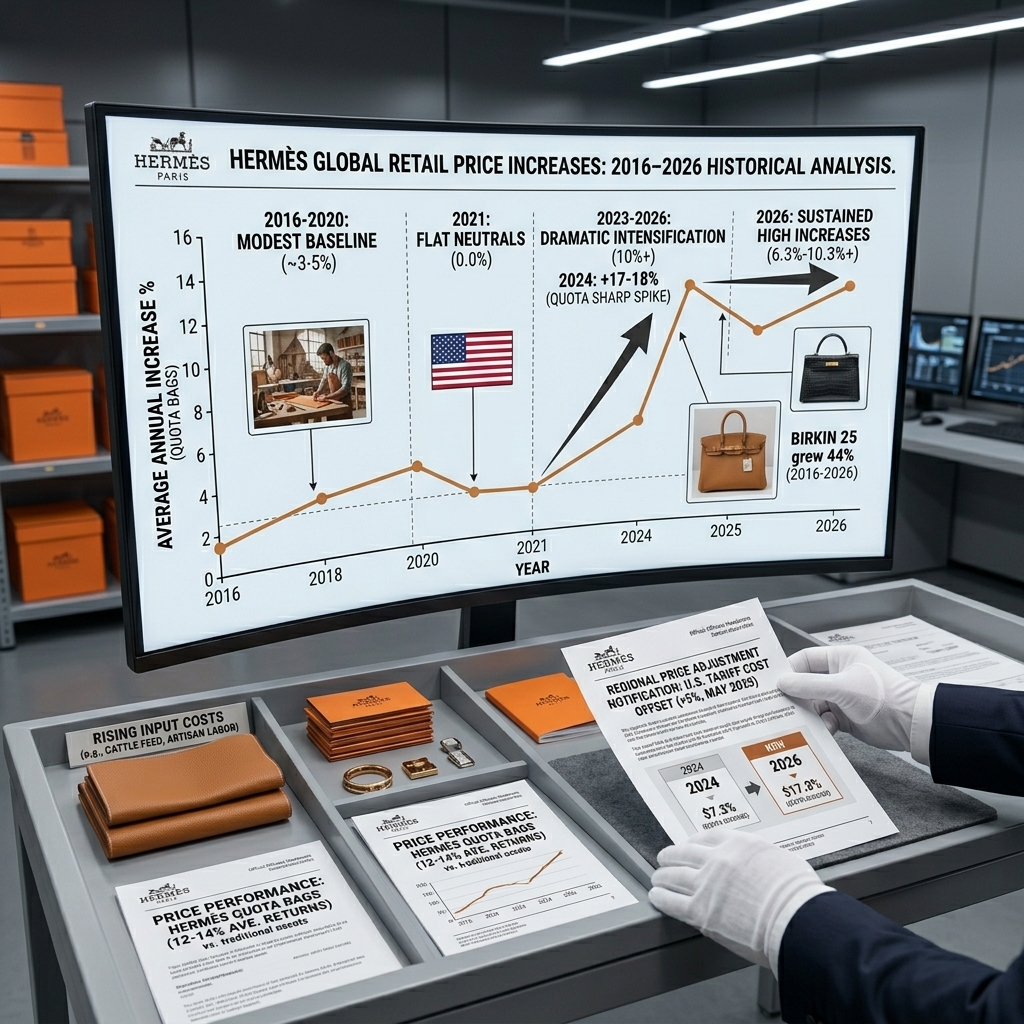
To navigate the market effectively, investors must root their strategy in the historical cadence of the brand. As established in our primary Investment Guide, Hermès operates with remarkable, almost brutal consistency. Historically, global retail prices are adjusted exactly once a year, typically executed in January for European markets and rolling out to the United States and Asia by early February. Mid-year adjustments are exceptionally rare and are generally only deployed to correct massive currency arbitrage discrepancies.
Prior to the 2020s, these annual adjustments hovered comfortably around 2% to 4%—a predictable reflection of standard European inflation and labor costs. However, the paradigm shifted drastically in the post-pandemic era. By 2023 and 2024, we witnessed structural increases of 8% to 12% across highly liquid quota bags. A Birkin 25 in Togo leather, which sat securely under the $10,000 threshold for years, vaulted aggressively past $11,000.
These adjustments are not arbitrary profit grabs; they are meticulously calculated recalibrations designed to reflect the soaring costs of raw materials and artisanship, a dynamic thoroughly detailed by our sister site in their analysis of the rising science and cost of heritage leather sourcing. More importantly for the investor, when the retail price of a quota bag increases by $1,000, the barrier to entry rises proportionally. Because your boutique relationship hinges on a spend ratio relative to the bag's cost, an 8% price hike simultaneously increases your required non-quota pre-spend by thousands of dollars overnight.
Manipulating the Price Delta on Secondary Platforms
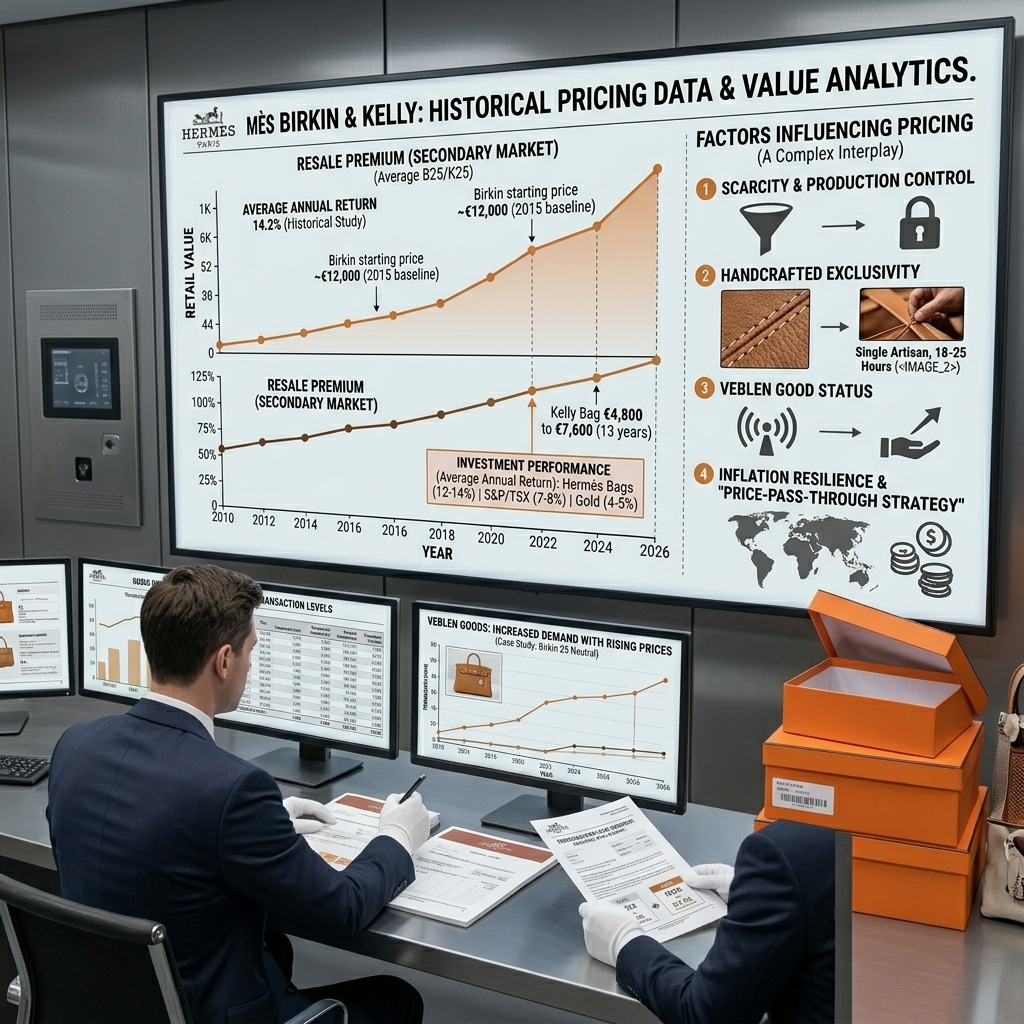
The most profound impact of a retail price increase occurs not in the boutique, but on resale platforms like Vestiaire Collective, The Real Real, and Fashionphile. The secondary market is highly reactive. The moment a global retail hike is confirmed, the floor price of every pristine asset on the secondary market surges.
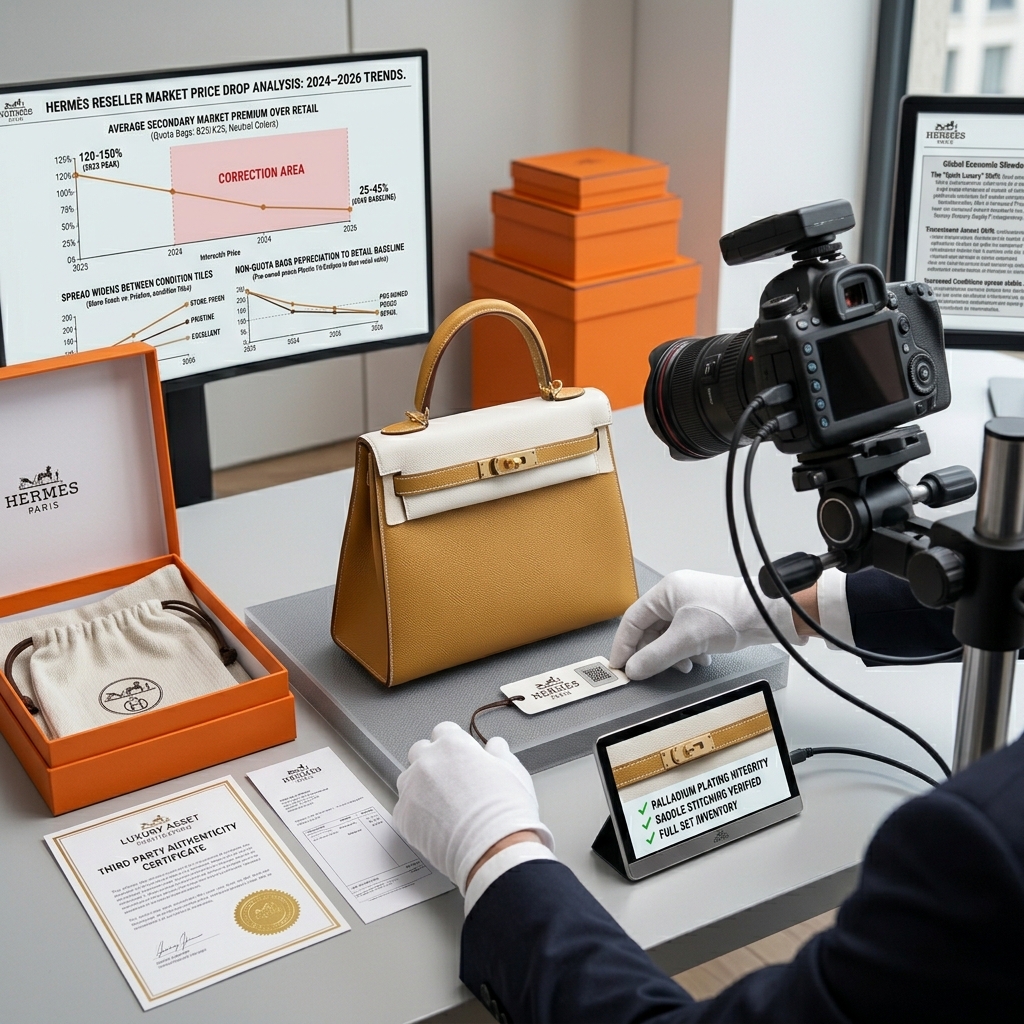
Consider the mechanics of the price delta. If a Birkin 30 historically commands a +80% premium over retail on the secondary market, a $1,000 increase at the boutique level translates to a nearly $1,800 increase in its price-to-resale ratio on Fashionphile. The premium multiplier remains constant, meaning the raw dollar profit for the seller actually expands. This phenomenon creates severe volatility. As we explored in our 2024–2026 reseller market price drop analysis, buyers who panic-purchased during the hype cycle are now finding that the only thing rescuing their ROI is the relentless, compounding effect of Hermès' annual retail adjustments.
However, this rising tide does not lift all assets equally. Condition grade becomes violently important. A pristine, store-fresh Hermès Special Service (HSS) bag will absorb the price hike perfectly, maintaining its high liquidity. A bag graded 'Very Good' or 'B' with visible corner wear will struggle. Buyers are willing to pay the newly adjusted premium for perfection, but they refuse to subsidize the inflated baseline cost for damaged goods.
- Monitor early January Euro-zone pricing; it reliably predicts the percentage increase hitting the US market weeks later.
- Do not liquidate Pristine quota bags in December. Hold through the January adjustment to capture the artificially raised secondary market floor.
- Ensure absolute preservation of provenance. An asset missing its receipt will not successfully command the post-increase premium delta.
The Impact on Non-Quota Assets and Fine Jewelry
While quota bags capture the headlines, the sophisticated collector also tracks how price hikes devastate the entry-level tier. Historically, Hermès has applied steeper percentage increases to lower-priced, highly liquid goods—such as silks, shoes, and non-quota bags like the Picotin and Evelyne—to aggressively defend their margins against casual, entry-level shoppers.
As documented in our 2026 guide to entry-level bags under $3,000, the window to acquire a Picotin 18 at a highly favorable price-to-resale ratio is closing rapidly. When a $2,800 bag suffers a 10% hike, it fundamentally alters its identity from a "casual impulse buy" to a calculated investment. Unfortunately, the secondary market for non-quota bags operates on tighter margins. An Evelyne TPM does not command the massive premium multiplier of a Birkin, meaning retail hikes on these items often compress the seller’s potential profit margin rather than expanding it.
The Q4 Boutique Frenzy
Because the annual January price increase is now an established reality, the fourth quarter (October to December) triggers immense boutique friction. Clients rush to complete their spend ratios, desperate to force their Sales Associate (SA) to offer a quota bag allocation before the financial goalposts are moved. The informal wait list becomes paralyzed. If you are attempting to secure a bag in December, you are competing against the most aggressive capital deployment of the entire year.
Furthermore, one must analyze the acquisition vehicles used to reach these quotas. Fine jewelry, a cornerstone of building a robust profile, is heavily impacted by the fluctuating costs of precious metals. Our deep dive into fine jewelry vs bag investment return proves that buying a rose gold bracelet in December before the annual adjustment is an immediate safeguard of your portfolio's raw capital.
Acquisition Timing and Liquidation Strategy
Navigating these scheduled market disruptions requires strict operational discipline. If you are currently building a boutique relationship and your spend ratio sits at 1.5:1 in November, you must execute the remainder of your spend immediately. Waiting until February means the retail price of your desired Birkin will likely jump, consequently increasing the required dollar amount of your ratio, forcing you to buy more non-quota items to catch up to the new baseline.
For those holding assets, the strategy is entirely inverted. If you possess a highly liquid, pristine Kelly 28 Sellier, delist it in late Q4. Let the retail price hike take effect in Q1, watch the resale platforms automatically recalibrate their algorithms upwards, and relist the asset in March. You will capture the exact same demand, but at a 10% higher price delta.
Ultimately, treating Hermès as a serious financial asset means abandoning the emotional aspect of the purchase. You are trading against a corporate entity that aggressively manages its own scarcity and inflation. Aligning your buying and selling patterns with their fiscal calendar is the only mathematical way to guarantee maximum return on investment.
| Asset Category | Avg. Historical Increase (YOY) | Secondary Market Impact | Liquidation Timing Strategy |
|---|---|---|---|
| Quota Bags (Birkin/Kelly) | 8% – 12% | Premium multiplier expands (Highly Profitable) | Hold through January; Sell in Q1/Q2 |
| Non-Quota (Picotin/Evelyne) | 10% – 15% | Margin compression (Retail catches up to resale) | Liquidate pre-hike if condition is declining |
| Fine Jewelry / Watches | 5% – 9% | Moderate price-to-resale ratio boost | Acquire in Q4 to lock in lower spend ratio |
| HSS / Special Order | 10%+ | Exponential premium growth (If neutral) | Hold as long-term vault asset |
The Market Insider's Verdict
Hermès price increases are the most predictable and lucrative drivers of secondary market premiums in the luxury sector. Failing to time your acquisitions and liquidations around the January adjustment destroys capital efficiency. Bottom Line: To maximize your ROI in 2026, aggressively complete your boutique spend ratios in Q4 to lock in current pricing, and strictly hold your pristine resale inventory through the Q1 price hikes to capture the artificially raised secondary market floor.
Popular Searches
Explore our most searched price history and investment questionsHermès Price Increase 2026 Predictions
Analyzing Euro pricing data to forecast the exact percentage hikes hitting the US market.
📈 Strong ResaleBirkin 25 Retail vs Resale Price History
Tracking the compounded annual growth rate of the most liquid quota bag in existence.
⬆ Rising DemandPicotin 18 Price Increase History
How aggressive retail hikes are pricing entry-level buyers out of the boutique experience.
★ Collector FavouriteDoes Fine Jewelry Hold Value After Price Hikes
Evaluating the true price-to-resale ratio of Hermès gold and diamonds over a 5-year hold.
