
Storing Hermès Bags in High Humidity: The Right Method
Market Intelligence: Defending Your Assets Against Catastrophic Environmental Depreciation
Understanding the exact science of storing Hermès bags in high humidity is not a domestic chore; for the luxury investor, it is critical asset defense. When navigating the 2026 secondary market, an investor's greatest adversary isn't necessarily shifting trends or retail price hikes—it is environmental degradation. A pristine quota bag allocation, secured after years of meticulous spend ratio engineering at the boutique, can have its entire price-to-resale ratio obliterated by three months of improper storage in a humid climate. Mold penetration, hardware oxidation, and structural collapse caused by excess moisture are treated by major resale platforms as catastrophic, irreversible damage. Buyers on Vestiaire Collective and Fashionphile will instantly reject a bag carrying the faint, unmistakable odor of mildew, rendering a $20,000 asset functionally illiquid overnight. In this comprehensive analysis, we elevate climate control from a care recommendation to a strict financial protocol. We will dissect how humidity attacks specific Hermès leathers, outline the exact storage conditions required to maintain a Pristine condition grade, and reveal how to prevent your capital from literally evaporating in your closet.
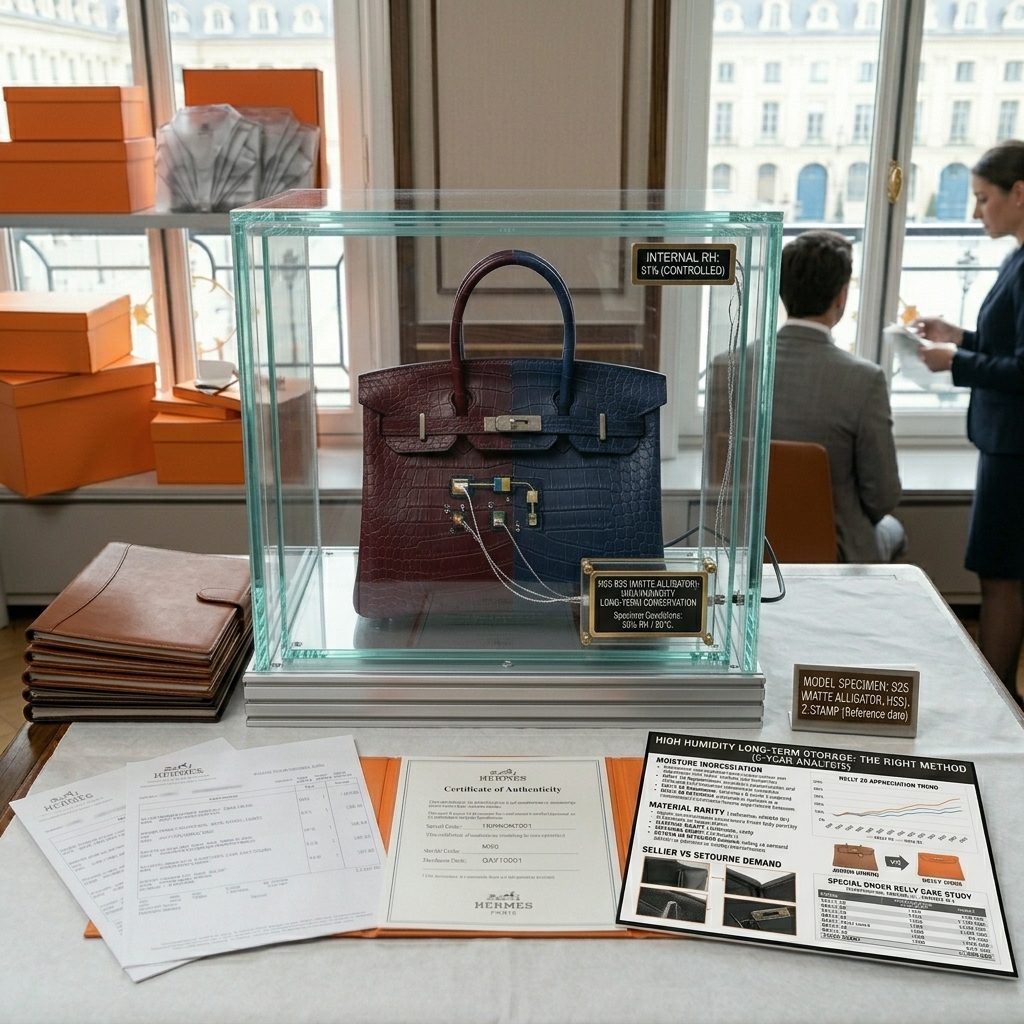
45% – 55%
Target Vault Humidity Level
-100%
Liquidity Drop for Mold Damage
Pristine
Condition Grade Protected
Table of Contents
The Financial Cost of Environmental Damage
Before implementing a storage strategy, the collector must consult our foundational Care & Storage Guide to understand how authenticators grade environmental wear. Unlike a corner scuff or a pen mark on the interior—which can occasionally be mitigated or forgiven by a buyer seeking a discount—moisture damage is pervasive and systemic.
When a Sales Associate (SA) hands you a factory-fresh Birkin 25, the leather holds a precise balance of natural oils. If you transport that bag to a tropical climate (or even a poorly ventilated summer home) and leave it in a stagnant closet where the relative humidity exceeds 65%, you trigger a biological reaction. Fungal spores naturally present in the air attach to the organic leather and begin to colonize. Once mold penetrates the grain of Togo or Clemence leather, it embeds deep into the fibers. You cannot simply wipe it away. The resulting musty odor is permanent.
From an investment perspective, an odorous bag is a dead asset. If you submit a mold-affected Kelly to The Real Real or Fashionphile, their authenticators will reject the consignment immediately, citing biohazard and quality control standards. You are left holding a highly depreciated asset with zero commercial liquidity. The price delta you spent years cultivating via your boutique relationship vanishes. Therefore, controlling the relative humidity of your storage environment is the only way to lock in the capital gains of your Hermès portfolio.
Leather-Specific Vulnerabilities to Moisture
The speed and severity with which a quota bag deteriorates in high humidity depend entirely on the specific leather. In the Hermès ecosystem, not all skins react equally to environmental stress. The investor must tailor their storage protocols to the specific vulnerabilities of their portfolio.
Heritage, smooth leathers such as Box Calf and Swift are notoriously sensitive. High humidity doesn't just invite mold; it causes the leather to blister. If moisture settles on the surface of Box Calf, it can raise the grain, creating permanent, bubbly welts that the Hermès spa cannot iron out. This immediately downgrades the bag's condition grade. Conversely, heavily textured, slouchy leathers like Togo and Clemence present a different challenge. Because these leathers are porous and naturally heavy, excess ambient moisture causes them to absorb water weight. A Togo Birkin 35 left in a humid room without proper internal support will undergo rapid structural collapse. The leather becomes damp and heavy, causing the base to puddle and the gussets to cave inward. To defend against this specific degradation, an internal exoskeleton is mandatory. We rigorously analyze these supports in our guide on the best bag inserts for Birkin 30 structure.
Epsom leather, being a stamped, resin-coated skin, is the most resilient against ambient humidity. It will not slouch, and it resists moisture penetration better than its organic counterparts. However, Epsom is not invincible. While the exterior might survive a humid summer, the interior lining of almost all quota bags is crafted from delicate Chevre (goatskin). If the internal micro-climate of the bag is allowed to become damp, the Chevre lining will peel and degrade, destroying the asset's provenance from the inside out.
- Maintain a strict macro-environment humidity level between 45% and 55% for all organic leathers.
- Never store an empty Togo or Clemence bag in a humid room; the added water weight accelerates structural slouching.
- Treat Box Calf and Swift as hyper-sensitive assets requiring dedicated, climate-controlled vault storage.
Hardware Oxidation and Color Transfer Risks
While leather degradation is the primary concern, high humidity introduces two devastating secondary threats: hardware oxidation and rapid dye transfer. Both of these phenomena directly attack the aesthetic perfection demanded by secondary buyers.
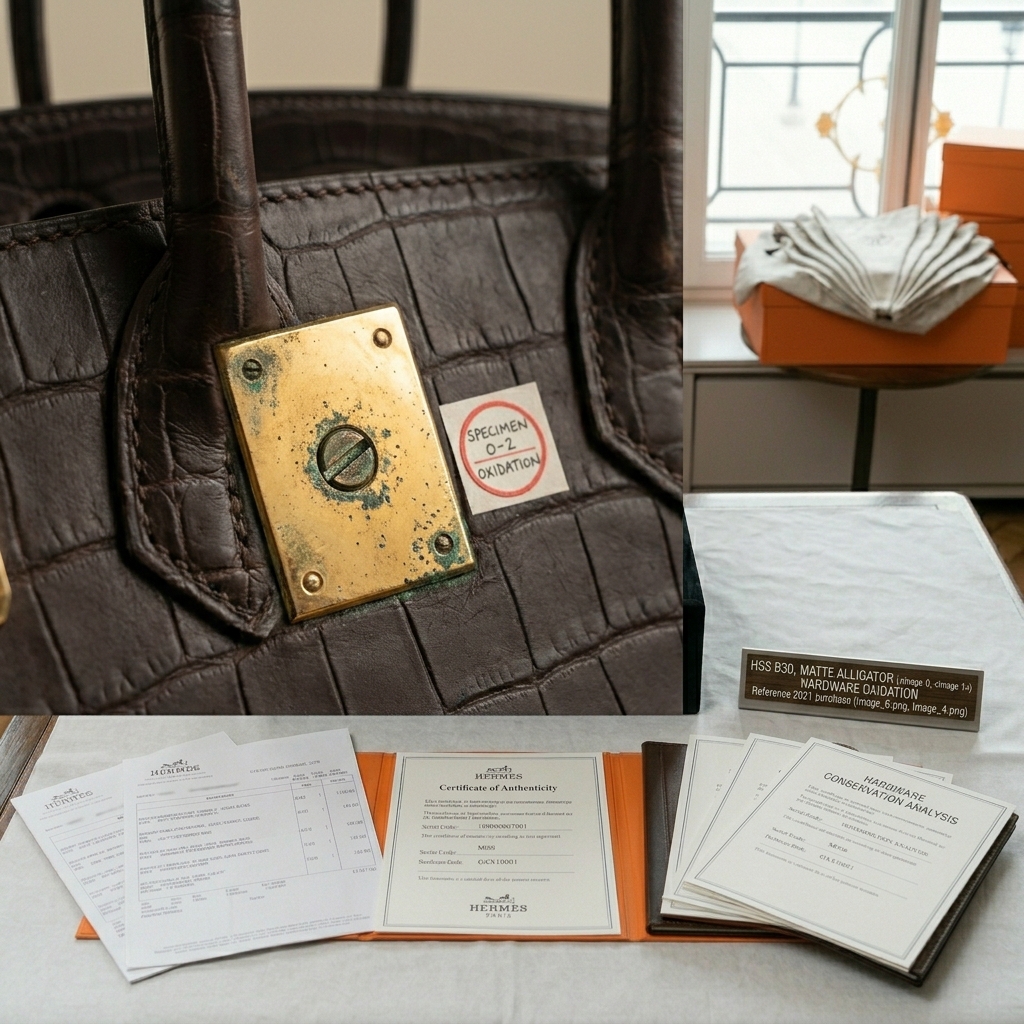
Hermès Palladium (PHW) and Gold (GHW) hardware are premium alloys, but they are not impervious to atmospheric moisture. In high-humidity environments, a microscopic layer of moisture settles on the touret, the plaques, and the base studs (clous). Over months of stagnant storage, this moisture causes oxidation and tarnishing. If the hardware begins to pit (where the metal actually corrodes), the damage is irreversible. As any experienced seller knows, a deeply tarnished plaque instantly drops a bag's condition grade. To restore the bag's price-to-resale ratio, you must endure a costly and lengthy hardware replacement at the Hermès spa. For a forensic breakdown of how different atmospheric pressures interact with these specific alloys, our sister site provides an exhaustive analysis on humidity effects on Hermès leather and hardware science.
The Humidity-Induced Color Transfer Catastrophe
Humidity fundamentally alters the stability of Hermès dyes. In a dry environment, the dye in a dark garment (like raw denim) is stable. In a highly humid environment, the ambient moisture acts as a vehicle, allowing the dye to migrate instantly upon contact. If you carry a Craie or Nata Hermès Special Service (HSS) bag against dark clothing in a humid climate—or even store it touching a darker dust bag—the color transfer is aggressive and permanent. We detail the mitigation strategies for this exact crisis in our guide to preventing color transfer on light Hermès leather. Once a light-colored bag absorbs dark dye, its premium resale delta is effectively zero.
These risks emphasize that the battle against humidity is not just about preventing mold; it is about maintaining the absolute factory-fresh appearance required to command top-tier pricing on the secondary market.
Practical Storage and Vault Protocols
Execution of a proper storage strategy requires abandoning common, yet destructive, domestic habits. The most egregious error committed by new collectors is storing their quota bag inside the iconic orange Hermès box. Cardboard is a porous material that acts as a moisture sponge. In a humid climate, placing your Birkin inside the closed box traps the leather in a dark, damp micro-climate, accelerating mold growth exponentially. The orange box must be retained for provenance to preserve your price delta upon resale, but it must be stored separately from the bag itself.
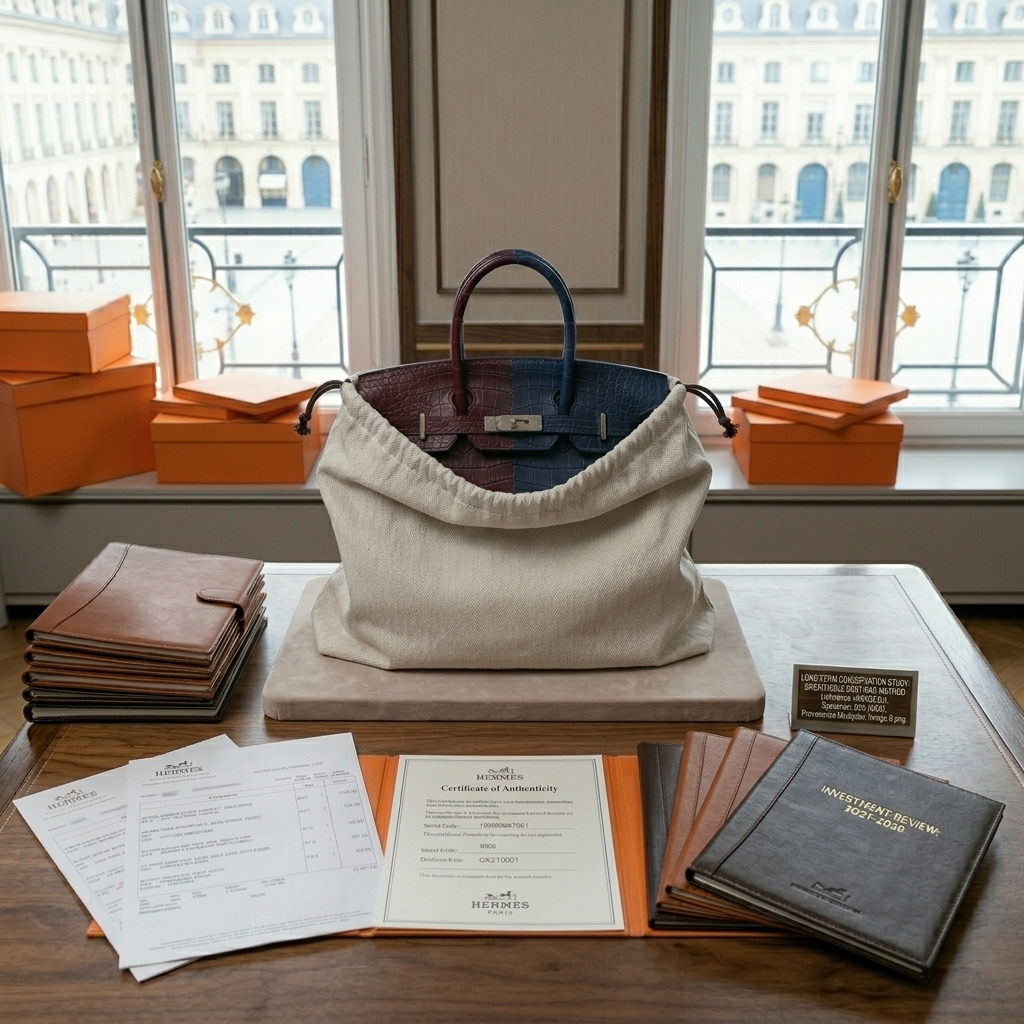
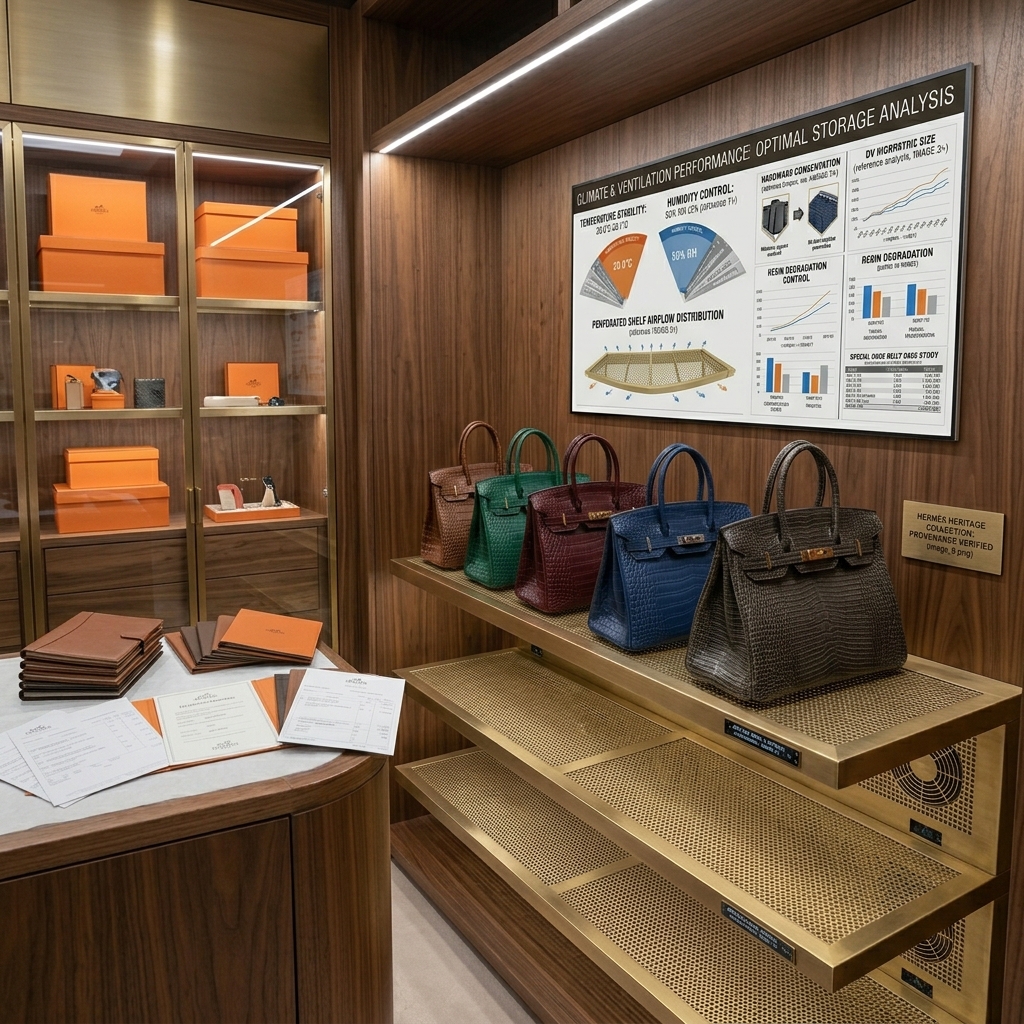
Your physical assets should be stored on open, ventilated shelves inside a dedicated, climate-controlled closet or vault. The bag should rest inside its breathable, herringbone cotton dust bag. To protect the interior micro-climate, utilize acid-free tissue paper or a premium, undyed felt insert to maintain shape while absorbing trace internal moisture. But beware the over-use of industrial desiccants (silica gel packets). Tossing handfuls of silica directly into the bag can aggressively over-dry the Chevre lining, causing the leather to become brittle and crack. A cracked interior is just as detrimental to your liquidity as a moldy one.
Instead of micro-managing the inside of the bag, you must manage the macro-environment. A high-quality, continuous-drain dehumidifier running in your closet is the only professional, foolproof method to protect a six-figure luxury portfolio. Ensure the ambient room temperature remains cool (around 68°F to 72°F) and the relative humidity is locked between 45% and 55%. If you are traveling and caught in a sudden downpour, you must intervene immediately; consult our analysis on the Hermès raincoat leather damage test to understand the protocols for active water exposure.
| Storage Method / Environment | Moisture Risk Level | Impact on Asset Condition Grade | Resale Price Delta Effect |
|---|---|---|---|
| Climate-Controlled Vault (45-55% RH) | Zero Risk | Preserves Pristine Grade | Maximum Premium Retained |
| Open Shelving in Standard AC Room | Low to Moderate | Maintains Excellent to Pristine | Baseline Premium Protected |
| Inside Closed Orange Box | Extremely High (Traps moisture) | High risk of mold/odor development | Catastrophic Liquidity Drop |
| Direct Contact with Silica Gel | High (Over-drying risk) | Risk of leather cracking/stiffness | Severe Resale Penalty |
The Market Insider's Verdict
The secondary market is mathematically merciless regarding environmental damage. No buyer will pay a premium to inherit your mold problem or oxidized hardware. Bottom Line: To absolutely guarantee the preservation of your asset’s condition grade and lock in your price-to-resale ratio, you must abandon the orange box for storage, invest in a dedicated macro-environment dehumidifier, and keep your collection resting in breathable dust bags on open, ventilated shelving.
Popular Searches
Explore our most searched environmental care and condition preservation questionsHow to Remove Mold from Hermès Birkin
Why biohazards result in instant rejection from authenticators and freeze secondary market liquidity.
📈 Strong ResaleCost of Hermès Hardware Replacement 2026
Tracking the exorbitant spa fees required to fix moisture-induced oxidation and tarnishing.
⬆ Rising DemandBest Way to Stuff a Kelly for Storage
Comparing acid-free tissue against premium inserts to prevent structural collapse in humid climates.
★ Collector FavouriteDoes Humidity Cause Hermès Color Transfer
Understanding how atmospheric moisture acts as a vehicle for irreversible dye migration on rare neutrals.
